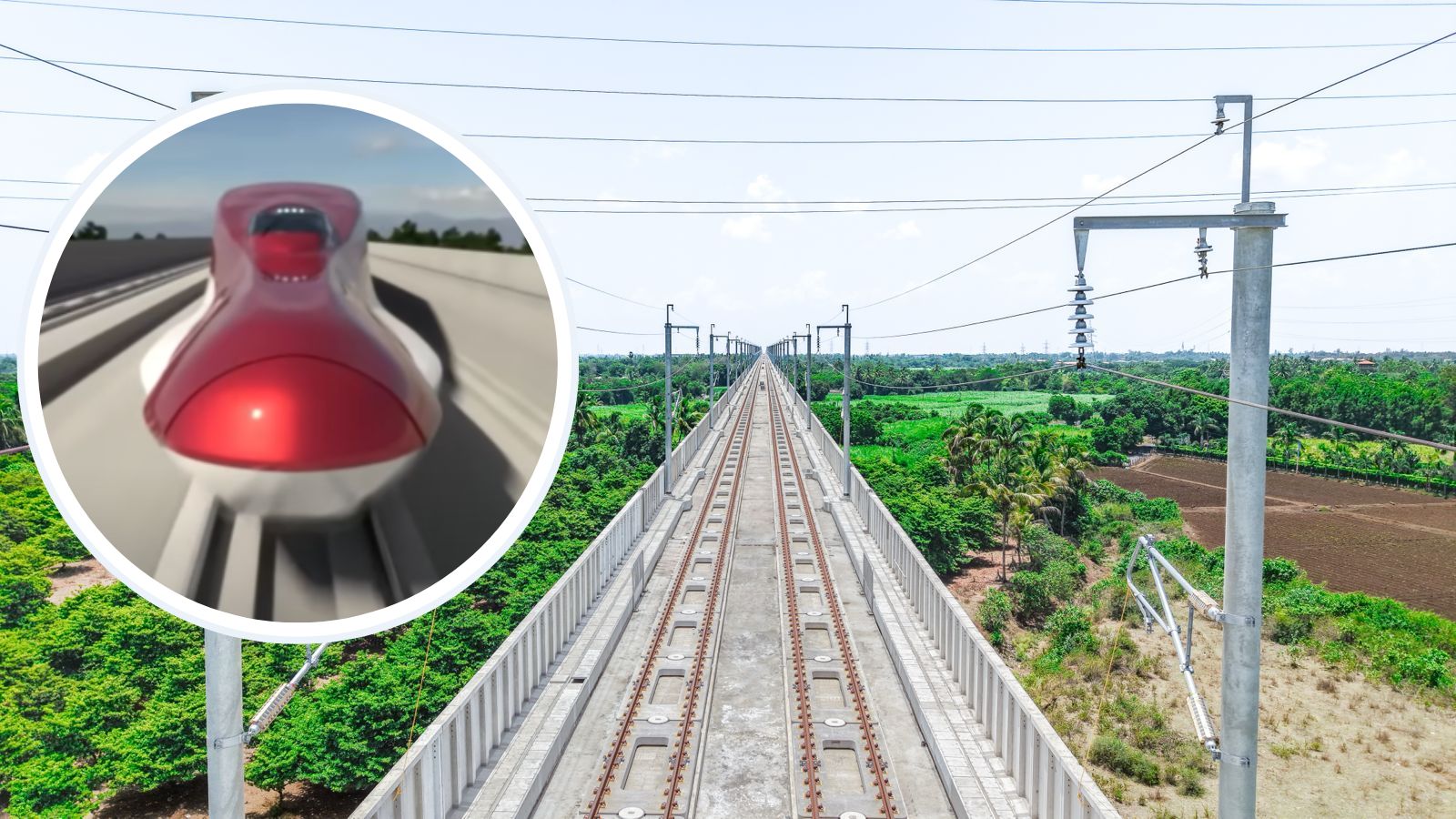
The Mumbai-Ahmedabad bullet train corridor is set to become India’s first railway line with a high-speed electrification system designed for trains running at speeds up to 320 kmph. According to National High Speed Rail Corporation Limited (NHSRCL), the 508-km-long Mumbai-Ahmedabad High Speed Rail (MAHSR) corridor is being equipped with an advanced 2x25 kV Overhead Traction System. This technology is being introduced in India for the very first time and is specifically designed to provide a stable and uninterrupted power supply required for trains operating at very high speeds up to 320 kmph.
The NHSRCL said electricity for the MAHSR corridor will flow from the National Power Grid and be supplied through specially designed grid substations and 14 traction substations located along the route. Of these, five substations are in Maharashtra: Mumbai, Thane, Virar, Boisar and Thane Depot; while the remaining nine are in Gujarat, including Vapi, Bilimora, Surat, Bharuch, Vadodara, Anand, Ahmedabad and Sabarmati Depot. These substations will feed power to different sections of the route, ensuring that as the Bullet Train moves from one section to another, the transition in power supply takes place seamlessly, without passengers even noticing it.
The corridor will also have 31 Switching Posts to ensure an uninterrupted power supply and enable rapid isolation of faults whenever required. Apart from powering the Bullet Trains, 16 Distribution Substations are being constructed to provide electricity for stations, signalling systems, maintenance facilities and other operational infrastructure. The bullet trains will run on a specially designed network of overhead electrical wires spread across 1,125 track km, including depots.
This network will be supported by nearly 22,000 steel masts and more than 25,700 cantilever assemblies. The masts, which are about 10.5 m to 14.5 m high, will support an advanced compound catenary system being introduced in the country for the first time. To achieve the speeds up to 320 kmph, every wire in this system is installed under precisely calculated mechanical tension, enabling the train’s pantograph to collect electricity smoothly and continuously, without sparks, interruptions, or power fluctuations.
Each traction substation will be equipped with an early earthquake detection seismometer that can detect seismic activity and initiate protective measures within seconds, allowing bullet trains to be stopped immediately in the event of an earthquake. In total, 28 seismometers are being installed – 22 along the high-speed corridor at Traction Substations and Switching Posts, and 6 additional inland seismometers in earthquake-prone regions of Maharashtra and Gujarat.