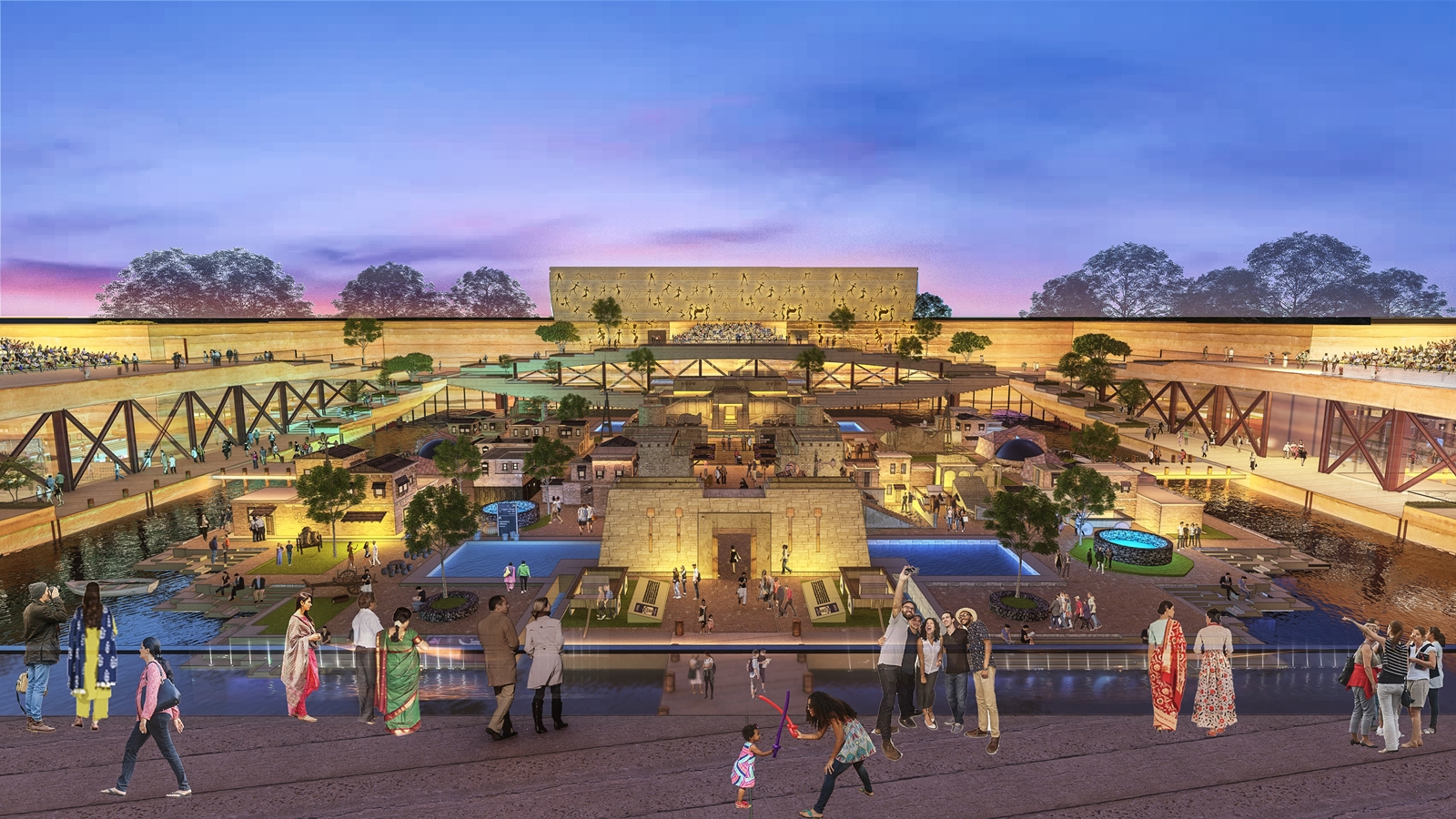
Visitors to Lothal, a prominent archaeological site of the Indus Valley Civilisation, will soon be able to experience life in a Harappan town, complete with markets, dockyards, and civic spaces. The National Maritime Heritage Complex (NMHC), a Rs 4,000-crore project, is being built near the site, about 80 km from Ahmedabad. The complex’s first phase, which includes six museum galleries, a jetty walkway, and a display of maritime artefacts, is set to be inaugurated within weeks.
Lothal, which existed around 4,500 years ago, is home to the world’s oldest known artificial dock, connected to an old course of the Sabarmati river. The recreation of the Harappan town is the centrepiece of the 375-acre project, which aims to create a world-class cultural and educational destination. According to Karl Wadia, Principal Architect at Architect Hafeez Contractor, the firm designing the project, the idea is to create an immersive experience for visitors to understand the advanced settlements of the Indus Valley Civilisation.
The complex will bring together museums, public landscapes, historic recreations, research facilities, eco-tourism, and entertainment programming. The maritime museum, which will be the world’s largest at roughly 7 lakh sq ft, will feature large-scale audio-visual projections, tactile exhibits, underwater-themed galleries, suspended ship installations, and digital storytelling environments. The museum’s design is inspired by the archaeological remains of Lothal, with monumental stone-clad forms raised on elevated plinths and inclined forms at the top resembling ship hulls.
Inside the museum, visitors will move through 14 interconnected galleries organised around a recreated Lothal settlement. The experience begins in an 18-metre-high arrival hall and unfolds through galleries featuring large water tanks with staged displays, immersive projections, suspended artefacts, and underwater-themed installations. The narrative spans ancient Harappan trade networks, Indian Ocean commerce, South Indian naval power, colonial encounters, and modern Indian shipping.
The project engages with the legacy of the Indus Valley Civilisation by reconnecting contemporary audiences with the sophistication, innovation, and global outlook of the civilisation. Lothal’s history as a significant maritime site made it a natural choice as the project’s grounding site, being home to the world’s earliest known man-made dockyard. The project has already signed MoUs with over a dozen countries for collaboration in developing NMHC as a global centre of maritime history.
Future phases of the project will introduce eco-resorts, museum-hotels, state-sponsored cultural pavilions, and themed attractions through public-private partnerships. The next phase, Phase 1B, will entail an investment of Rs 3,000 crore and include eight additional museum galleries and a 50-dome theatre, among other attractions.