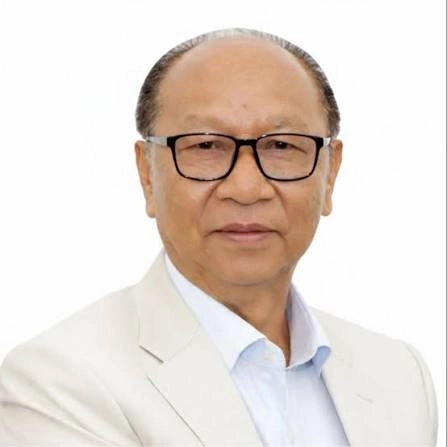
The passing of Niketu Iralu (1935-2026) marks the end of a remarkable life devoted not merely to the Naga cause, but to the larger human cause of reconciliation, justice, and peace. He was a nationalist without being imprisoned by nationalism, an internationalist without losing his roots, and a man of peace who understood that lasting political solutions are possible only when human relationships are healed. His life therefore deserves to be remembered not simply as the life of a prominent Naga, but as that of a bridge-builder between peoples, communities and conflicting worldviews.
Niketu Iralu came from Khonoma, a village deeply associated with Naga resistance and political history. He was also related to A. Z.
Phizo, one of the most important figures of the Naga national movement. Yet his own life’s journey took a distinctive direction. Rather than choosing the path of armed confrontation, he chose the difficult path of dialogue, reconciliation and moral transformation.
He worked internationally with the Moral Re-Armament movement, later known as Initiatives of Change, travelling across continents and encountering societies struggling with division and conflict. That international experience profoundly shaped his understanding of the Naga problem. Niketu’s nationalism was rooted in an intense love for his people, their history, dignity and aspirations.
But he understood something that is often forgotten in nationalist movements: love of one’s own people cannot require hatred of another people. This distinction was central to his life’s work. He recognized the legitimacy of Naga aspirations while simultaneously recognizing the necessity of living with neighbours and finding a peaceful relationship with India.
He repeatedly argued that even when political aspirations remained unresolved, Nagas could not afford to return to killing one another. His approach therefore placed human life and reconciliation alongside political objectives rather than beneath them. Perhaps Niketu’s most enduring contribution was his work on internal Naga reconciliation.
He understood that the Naga conflict was not simply a confrontation between Nagas and the Government of India. Over time, divisions among Naga groups, factions, tribes and communities had themselves become a devastating source of suffering. After the 1997 ceasefire, he became deeply involved in efforts to encourage dialogue among Naga groups.
In 2001, following the controversy and violence surrounding the extension of the ceasefire to Naga-inhabited areas outside Nagaland, the Naga Hoho entrusted him with convening a reconciliation committee. The committee sought both to promote reconciliation among Nagas and to reach out to neighboring communities whose fears had intensified. One of the most significant moments came on 20 December 2001, when representatives of more than 35 Naga tribes and sub-tribes, churches, civil-society organisations and Naga political factions participated in a major reconciliation gathering in Kohima. 132 Naga leaders signed a pledge committing themselves to practical steps towards restitution and healing.
Niketu’s international experience was not an ornamental part of his biography. It was fundamental to his intellectual formation. His decades of work with Moral Re-Armament/Initiatives of Change exposed him to conflicts across continents and to the possibility of transforming relationships through personal honesty, listening and trust-building.
Consequently, he brought an unusual perspective back to the Northeast: peace begins with the transformation of the individual. For him, conflict resolution was not simply a matter of conferences, accords and political institutions. It required people to examine their own prejudices, acknowledge their own responsibility and develop the humility to hear the pain of the other.
This philosophy explains why he continued to speak to students, young people, civil-society groups and ordinary citizens. As recently as February 2026, he was urging young people to accept personal responsibility for building a peaceful and just society rather than placing the entire burden on political leaders. Niketu Iralu was a teacher, but not primarily because he occupied a classroom.
His classroom was society itself. His lessons were simple but demanding: Listen before judging. Take responsibility before blaming.
Seek reconciliation before revenge. Change oneself before demanding that others change. Love one’s people without dehumanising others.
These ideas placed him in the Gandhian tradition of moral politics. He believed that political transformation without personal transformation would remain incomplete. His public interventions repeatedly stressed non-violence, individual responsibility, and the reduction of selfishness.
He was also a philosopher in the practical sense. His philosophy was not detached speculation; it was tested against the painful realities of conflict. He knew that peace is not the absence of disagreement.
Peace is the capacity to disagree without destroying one another. Niketu’s legacy should not be measured only by whether a final political settlement was achieved during his lifetime. His deeper legacy lies in the culture of peace that he helped create.
He demonstrated that Naga nationalism could coexist with non-violence, that reconciliation among Naga groups was possible even after terrible violence, and that neighbouring communities had to be part of the conversation. He was recognized by Initiatives of Change International with a Lifetime Achiever Award in 2025, acknowledging a lifetime devoted to trust-building in the conflict-affected Northeast. His participation in public discussions of the Naga conflict, including at Harvard University’s Asia Centre, demonstrated that his voice had relevance beyond the immediate political arena.
He was recognized there as a peace activist engaged in the continuing search for a peaceful resolution of the Naga conflict. The greatest tribute to Niketu Iralu is perhaps not to call him a ‘great peace activist,’ but to understand what kind of peace activist he was. He did not romanticize conflict, he knew its costs, and he refused to accept the proposition that political differences must inevitably become human hatred.
His life offers the Naga people, India, and the wider world a difficult but necessary lesson: a conflict is not truly resolved when the guns become silent; it is resolved when people who once feared or hated one another can again recognize each other’s humanity. His emphasis on listening became central to this philosophy. His home, known as Kerünyü Ki — the ‘Listening House’, became a place where people from different sides of conflicts could meet, speak and listen.
A recent academic study described his work as an important example of reconciliation through listening. Niketu Iralu was a nationalist because he loved his people. He was an internationalist because he saw their destiny as part of a larger human family.
He was a peacemaker because he refused to make an enemy of anyone. He was a teacher because he taught through his life. He was a philosopher because he asked people to examine themselves before judging others.
And he was a friend because he listened. His life reminds us that peace is not weakness, compromise is not surrender, and reconciliation is not forgetting. Peace is the courage to remember the wounds of history without letting them dictate the future.
May the memory of Niketu Iralu continue to inspire the Nagas to complete the work he devoted his life to: from conflict to conversation, from division to reconciliation, and from the pursuit of victory to the pursuit of a shared and dignified peace. — Besesayo Kezo, IPS Retd DGP