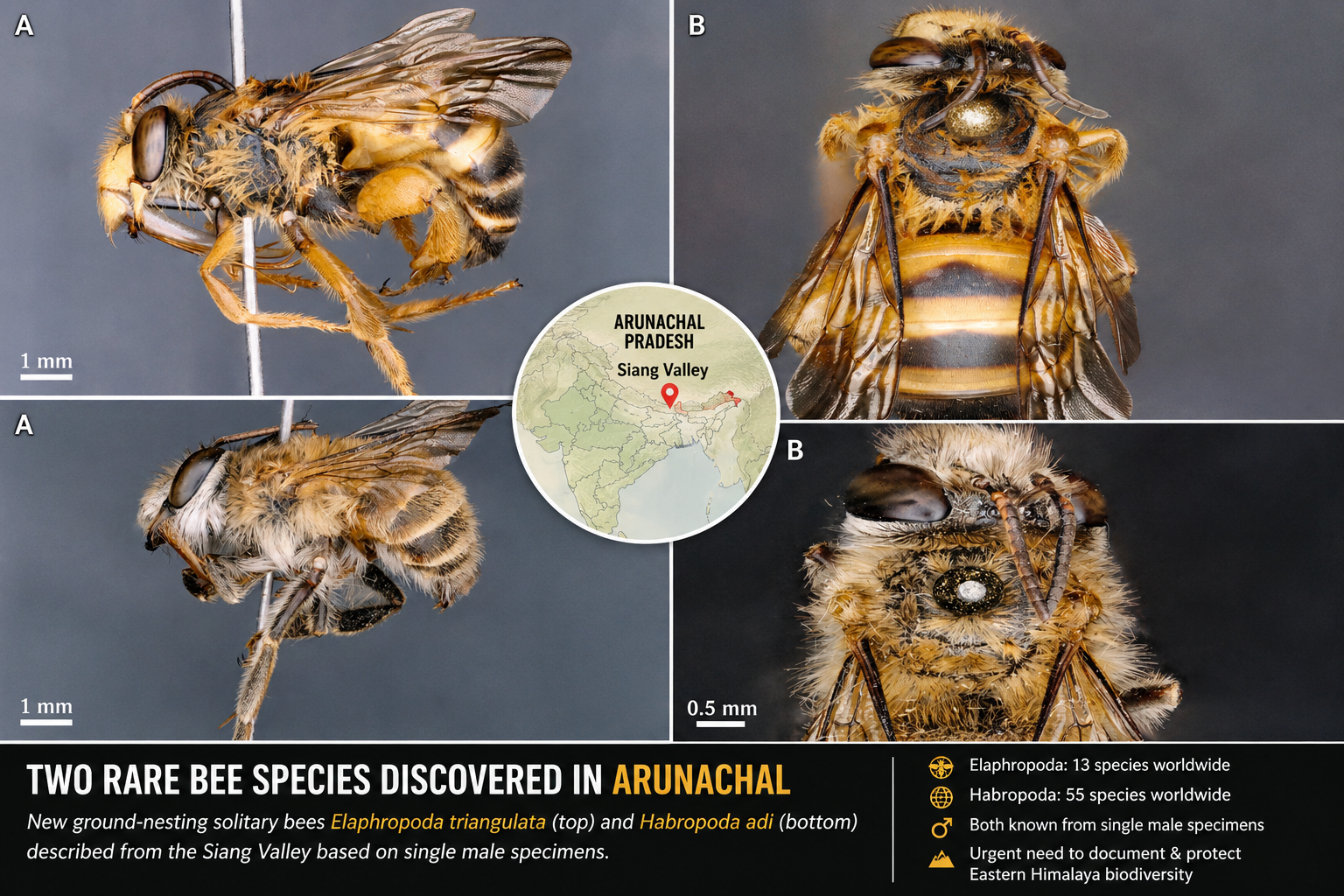
Scientists have made a groundbreaking discovery in Arunachal Pradesh, uncovering two new species of rare solitary bees that add to India’s growing biodiversity inventory. The findings, published in the European Journal of Taxonomy, highlight the urgent need to document and protect the Eastern Himalaya’s rapidly disappearing natural habitats.
The newly identified species, Elaphropoda triangulata and Habropoda adi, were discovered by researchers from the Ashoka Trust for Research in Ecology and the Environment (ATREE) during the Siang Expedition. Elaphropoda triangulata is named after the distinctive triangular markings on its abdomen, while Habropoda adi is named in honor of the Adi indigenous community. Both species belong to bee genera that are among the rarest known to science, with Elaphropoda comprising just 13 known species worldwide and Habropoda having only 55 species globally.
The discovery is significant, as each of the two newly described species is known from just a single male specimen collected in Arunachal Pradesh. The researchers chose to formally describe the species without waiting for additional specimens due to rapid infrastructure development, road expansion, and changing land use in the region, which could threaten their habitats before further surveys are completed.
The two bees belong to the Anthophorinae subfamily of ground-nesting solitary bees, a group of wild pollinators that plays a vital role in maintaining ecosystems and supporting agricultural productivity. Unlike honeybees, solitary bees do not live in colonies but are increasingly recognized worldwide for their importance in pollination.
Lead author Femi Ezhuthupallickal Benny emphasized that the discovery underscores how little is still known about India’s bee diversity.