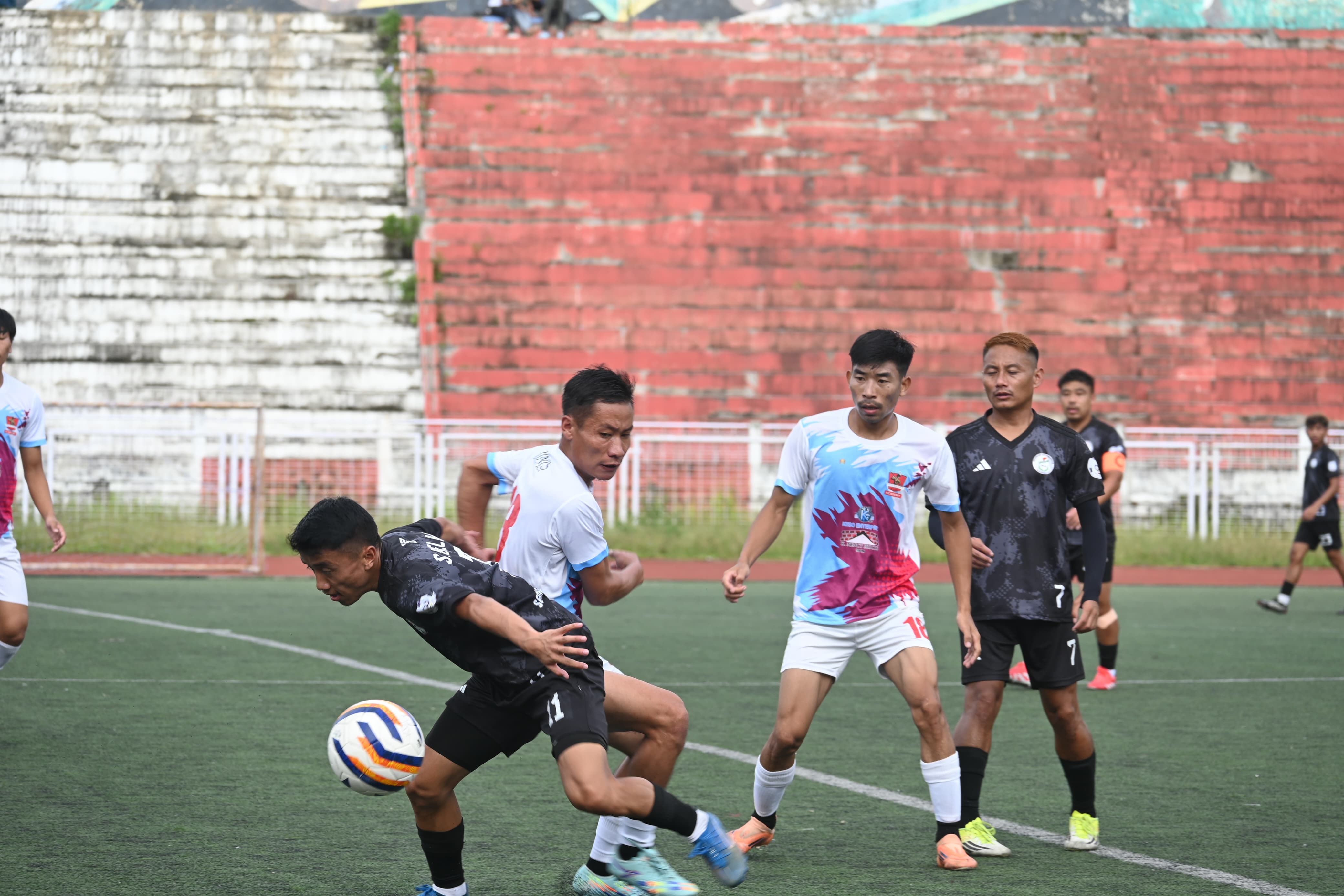
The Atuo Mezhür Sekhose Super League, organised by the Kohima District Football Association (KDFA), aims to address a familiar problem in football development: the need for structure, meaningful competition, and a pathway for talented players. The league, named after late Atuo Mezhür Sekhose, a prominent figure in Nagaland football, seeks to strengthen clubs, improve professionalism, and create a competitive environment built around discipline and sportsmanship. One of its most significant regulations requires every starting XI to include at least two Under-20 players.
Guest players are allowed, but there are limits, with teams able to register three guest players and only two permitted in the playing XI. This structural decision has potentially significant consequences, making youth development part of the competition itself. The first edition of the league has reached the end of its league stage, with Sechü Zubza FC emerging as the first league champions.
Sechü Zubza sealed top spot with a perfect record, defeating Mez & Co 3–1 at the Indira Gandhi Stadium. The result completed a dominant league campaign for Sechü Zubza, who finished with four wins from four matches, 12 points, 17 goals scored, and just four conceded. The league stage may now be over, but the competition continues.
Sechü Zubza will face Tsütuonuomia Youth Organisation (TYO) in the first semi-final of the Champions Cup, while Mez & Co take on Vanguard Academy. Both matches kick off at 6 pm, with the winners meeting in the Super Cup final on August 29 at 6 pm. Beyond the standings and the race for the Super Cup lies a larger question: can a league such as this become a foundation for the long-term development of football in Kohima?
For young players, the biggest challenge is often the jump between training and meaningful senior competition. The league’s objectives include creating a pathway for talented players and giving young footballers a competitive environment built around discipline and sportsmanship. The inclusion of Vanguard Academy adds another layer, with the club’s academy established in 2017 and designated a Khelo India Centre for Football in 2022.
The academy has worked across grassroots coaching, scouting, trials, and football clinics, with a particular emphasis on developing younger players. Its third-place finish and progression to the Super Cup semi-finals further underline the value of bringing teams from beyond Kohima into the competition. KDFA General Secretary Viliebeizo Liezietsu shared that one of the greatest challenges is financial sustainability.
The cost of running a league is continuous and substantial, covering venue hire, match officials, medical service, equipment, logistics, publicity, and match-day operations. Gate collections alone cannot sustain a competition of this nature, making long-term partnerships with sponsors, businesses, and the wider community crucial. Liezietsu noted that sponsors should not be viewed as charity, but as partners who create value through brand visibility, community engagement, and meaningful social impact.
He also pointed out that Kohima continues to have limited options for quality and accessible 11-a-side football pitches. While the Indira Gandhi Stadium remains an important venue, accessibility and location can influence both participation and spectator attendance. The Atuo Mezhür Sekhose Super League also carries a financial legacy component, with 20% of match-day ticket revenue being contributed to the Atuo Mezhür Sekhose Trust Fund.
This makes spectators part of the legacy project, and the more successful the league becomes commercially, the greater its potential contribution to the trust fund. At the league’s launch, Neidilhou Keditsu, Director of Economics and Statistics in the Nagaland government, described the competition as a landmark initiative for the state’s football landscape. He challenged the organisers and players to produce Nagaland’s next Messi, Ronaldo, or Bhaichung Bhutia.
Liezietsu also emphasized the need to invest in the people behind football, such as coaches, referees, medical personnel, administrators, and volunteers. Improving the standard of these support systems will directly improve the standard of football. Young players need regular competition, quality coaching, exposure, and a pathway to progress.
A consistent competitive calendar can help create an environment where players can gradually commit themselves more seriously to the game. Beyond player development, there is also a need to enhance the visibility and engagement of football. Professional media coverage, live and highlight streaming, accurate statistics, and an elevated match-day presentation can change how local football is consumed.
Football must be positioned not merely as a sport, but as a community experience. The more people engage with the game, the greater the potential for clubs and leagues to attract sponsors, build audiences, and create sustainable commercial models. The real test is bigger than the Super Cup.
The upcoming semi-finals will determine who plays for the Super Cup, but the more important result may not appear on the scoreboard. Can a district league become a serious development platform? Can clubs be encouraged to operate more professionally?
Can young players be given meaningful minutes without compromising competitiveness? Can sponsors see enough value to support the competition over multiple seasons? And can the league help establish a regular football calendar in Kohima?
The final whistle on August 29 may close the inaugural chapter, but for Kohima football, the hope is that it marks the beginning of a much longer season.