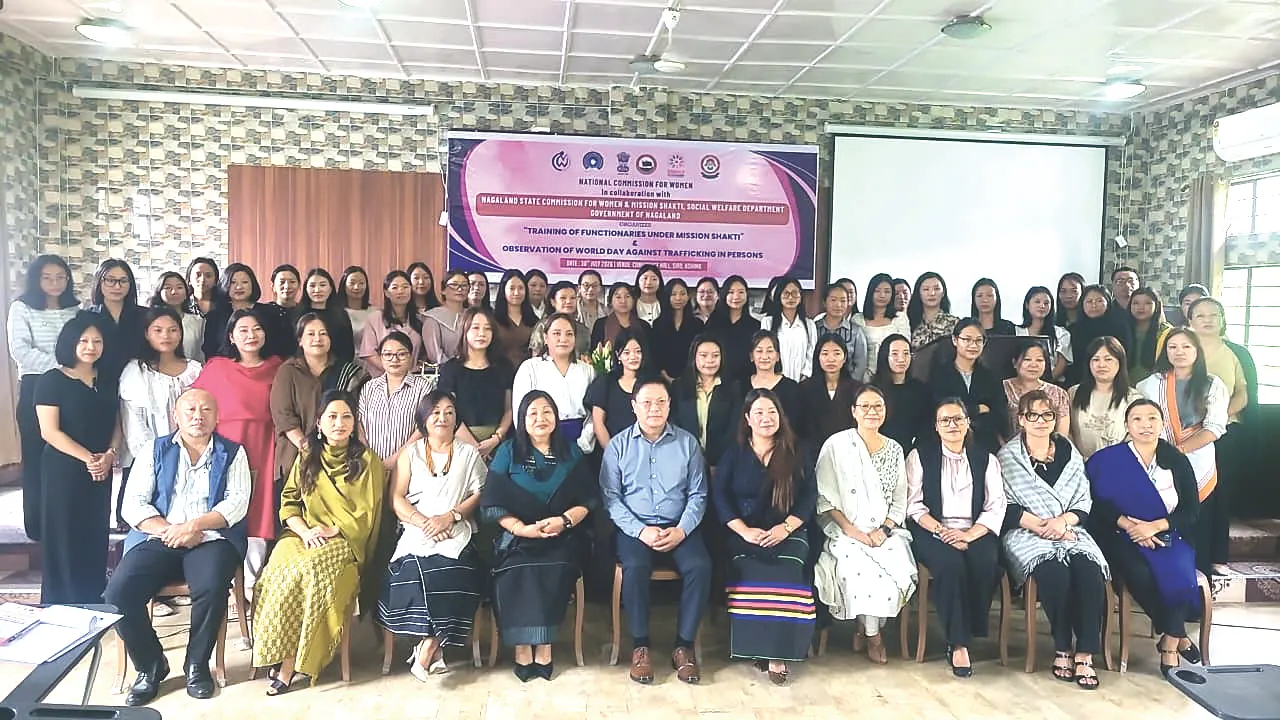
Nagaland continues to face the dual challenge of being a source, transit route, and destination for human trafficking, according to Social Welfare department secretary and administrative head of department Limawabang Jamir. Speaking at a training programme for Mission Shakti functionaries on July 30, Jamir noted that trafficking in Nagaland has largely involved child domestic labour, commercial sexual exploitation, and illegal or fraudulent child adoptions disguised as opportunities for free education. The training programme, organised by the National Commission for Women in collaboration with the Nagaland State Commission for Women and Mission Shakti under the Social Welfare department, was held at the SIRD Conference Hall in Kohima and aimed to build a cadre of well-trained Mission Shakti personnel capable of responding effectively to gender-based violence.
The programme also marked World Day Against Trafficking in Persons. Jamir urged all stakeholders to intensify awareness efforts and equip vulnerable women and children with the knowledge to protect themselves. He highlighted the department’s recent work, including the establishment of Women Helpline-181, Sakhi One Stop Centres in all 17 districts, and Shakti Sadans in six districts.
Jamir also appreciated the commitment of Mission Shakti personnel despite various challenges and said the department had taken up the issue of pending honorarium with the ministry for early release. One Stop Centres handled 125 cases of gender-based violence between April and June this year, while Women Helpline-181 attended to 53 cases involving gender-based violence and information-seeking calls. Additionally, Mission Shakti centres across the state had been working tirelessly to ensure the safety and security of women.
NSCW chairperson W. Nginyeih Konyak described human trafficking as a modern form of slavery preying on vulnerable women and children. She emphasised the need for a proactive, comprehensive, and relentless response to the issue.
Nginyeih highlighted Mission Shakti’s role in women’s safety and empowerment and called for stronger coordination among the Social Welfare Department, NSCW, district administration, police, village councils, and student bodies. The programme was chaired by NSCW member Kekhrienuo Meyase. Social Welfare director Tosheli Zhimomi noted that during 2025-26, One Stop Centres handled 311 cases, while Women Helpline received 2,090 calls, including 144 requiring intervention.
She urged Mission Shakti personnel to continue working closely with Mission Vatsalya and other departmental programmes to ensure timely support for women and children.