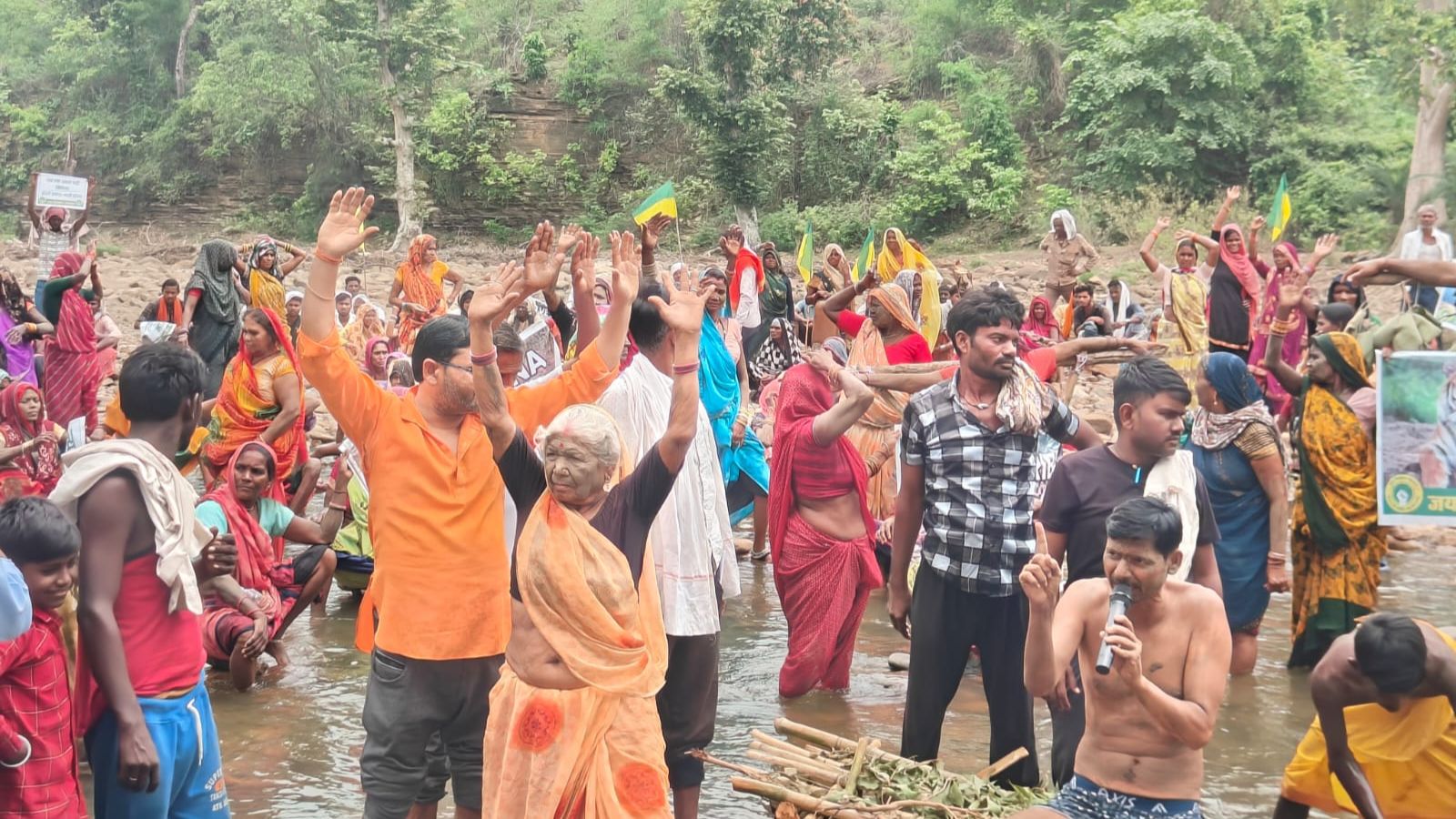
Amit Bhatnagar, the leader of the Ken-Betwa protest, was detained by the Madhya Pradesh Police on Sunday morning, bringing an end to a two-week agitation against the Rs 44,605-crore Ken-Betwa Link Project. Bhatnagar had been on an indefinite fast for 14 days, emerging as the face of protests over alleged irregularities in land acquisition, rehabilitation, and compensation for families affected by the project. The Ken-Betwa Link Project, India’s first river-linking project, aims to transfer water from the Ken River to the Betwa basin through the Daudhan Dam and a network of canals, providing irrigation, drinking water, and hydropower across Madhya Pradesh and Uttar Pradesh.
However, the project requires the displacement of nearly 2,000 families from villages falling within the reservoir’s submergence, leading to protests. Several platoons of local police in riot gear arrived at the protest site, where Bhatnagar and the protesters kept their distance by wading into the river. The police tried to convince them to call off the protests, and eventually, Bhatnagar was detained and taken to the local hospital for treatment due to his deteriorating health.
Bhatnagar, visibly frail after two weeks without food, had been too weak to walk on his own and was often carried by fellow protesters between demonstrations. He had also helped coordinate the movement of women protesters from the flooded area before returning to his cot. Around 150 protesters were also detained, packed into buses, and sent to Panna district.
According to Additional SP Aditya Patle, the detained protesters were not from the locality but from Panna, who had issues with other dam projects. The police investigation showed that these protesters were not directly affected by the Ken-Betwa project, and therefore, they were sent to Panna. Bhatnagar, a social activist, has been involved in campaigns related to land acquisition, environmental compliance, and the rights of project-affected families.
Hours before his detention, Bhatnagar spoke to The Indian Express, pointing out ‘irregularities’ in the land acquisition process. He alleged that the government had not been fair and transparent in its land acquisition process, and there were many irregularities in the disbursement of compensation. He claimed that the proceedings registers of the Gram Panchayats contained identical word-for-word entries, raising questions over the authenticity of the proceedings.
Bhatnagar also alleged that around Rs 11 crore had been sanctioned as compensation for houses in Kharihani village, while documents available with him suggested nearly Rs 8 crore was paid to people who either had no connection with the village or had migrated away decades ago. He also claimed compensation had been sanctioned in the name of a Muslim family, although, according to villagers, no Muslim family ever lived in Kharihani. Chhatarpur Collector Parth Jaiswal rejected the protesters’ allegations, saying most of those participating in the agitation were not directly affected by the Ken-Betwa Link Project.
He also rejected allegations that Gram Sabha proceedings had been fabricated, stating that there were no irregularities in the Gram Sabha records. However, Jaiswal acknowledged that several protesters were raising issues related to other dam projects in neighboring Panna district, which did not fall under the Chhatarpur administration’s jurisdiction. Jaiswal also stated that the Muslim family, which was sanctioned compensation, owned fertile agricultural land in Kharihani village and had been compensated for the acquired land, not for residential status in the village.
The administration was examining genuine grievances relating to the Ken-Betwa project through the prescribed process.