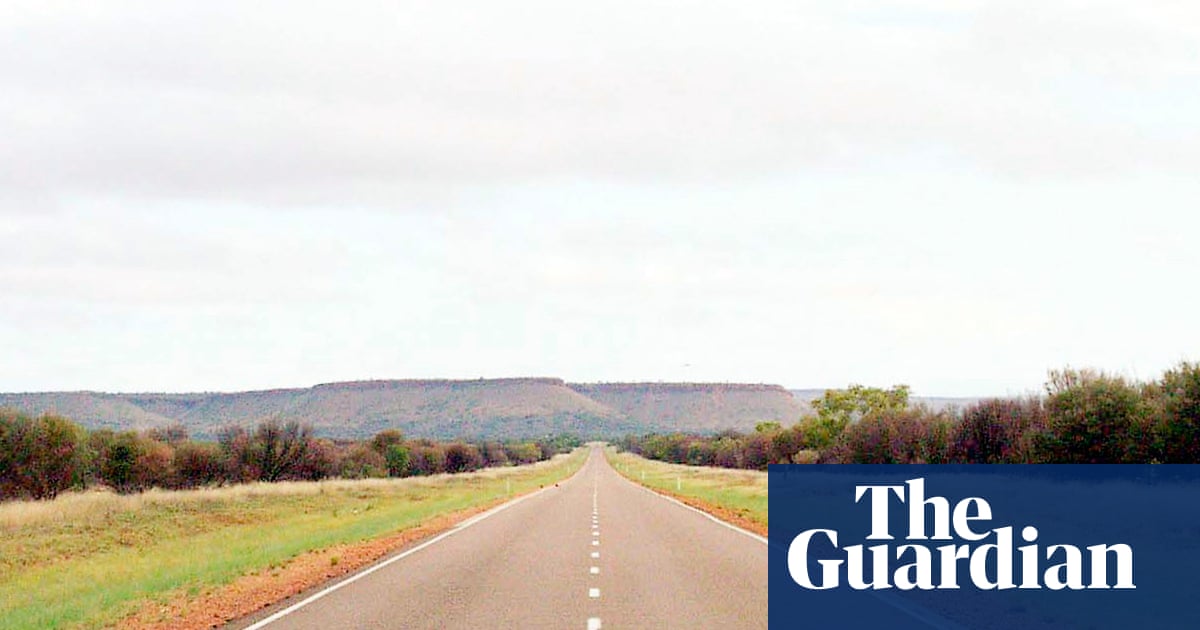
A former British government expert who consulted on the search for the remains of murdered backpacker Peter Falconio believes he has identified a ‘most likely’ potential burial location – an abandoned racetrack only 8km from the scene of the infamous outback attack at Barrow Creek. Dr Mark Harrison, the UK’s national police search adviser in the early 2000s, says the chances of locating Falconio’s body remained ‘high’ and that he had identified five possible burial locations using a combination of criminal profiling and physical site analysis. In July 2001, Falconio and his partner, Joanne Lees, both from Yorkshire, were ambushed and attacked by Bradley John Murdoch as they drove along a remote stretch of road in Australia’s Northern Territory.
Falconio was shot and killed at the roadside, while Lees managed to flee into the darkness and hide in the scrub for hours. Murdoch was convicted of Falconio’s murder in 2005 but never admitted his guilt or spoke about where he took the backpacker’s remains. He died in prison last year.
This week, 25 years after the attack, the Northern Territory police released a video of an agitated Murdoch refusing to reveal the location before his death. ‘I know nothing,’ he says. The decades-long police search for Falconio’s remains has been underpinned by two assumptions: the search is a ‘needle-in-a-haystack’ effort in an incredibly large area, and only Murdoch could ever lead authorities to the site. However, Harrison disagrees, saying that advances in technology would allow for a ‘high assurance’ search, including the use of drones, radar, and a dog.
Harrison returned to the outback this year with retired FBI criminal profiler Kathy Canning-Mello and visited the potential locations. After working with Canning-Mello, he revised five potential sites from his earlier reports down to three, but believes the most likely potential burial site is the disused racecourse. ’We have a phrase in this type of work, whenever we work on a cold case we say, ‘You must clear the ground from under your feet,’ Harrison says. ‘What we mean by that is that the nearest most proximate location must be considered.’ This means that the racecourse, being the nearest location to the attack site, should be thoroughly searched. The racecourse stands out due to its proximity to the attack site and its unique geography.
Harrison says that Murdoch, a one-time interstate drug runner, was familiar with the terrain and would have known the racecourse was there. He also believes that the intended location for Lees’ abduction became the burial site after she escaped. The racecourse provides good cover from view, with old buildings and canopy cover, making it an ideal location to conceal a body.
Lees told police that after Murdoch searched for her along the highway, he drove south towards Alice Springs. CCTV footage of the killer arriving at an Alice Springs petrol station that night leaves about 90 minutes unaccounted for. Harrison says that Murdoch had time to dispose of Falconio’s body and conceal it in a manner that he was confident would not be found.
The Northern Territory police searched the racecourse in the aftermath of the killing but did not locate a well-concealed body. Harrison says that the search was not thorough enough and that advances in technology would allow for a more comprehensive search. The process could be conducted for less than the cost of the $500,000 reward for information, which remains in place despite Murdoch’s death.
Harrison’s involvement in the case was at the expense of the British government, and he had access to the entire case file. He says typically his involvement in cases would involve identifying sites, developing a search strategy, then having some involvement or oversight of the search. However, the Falconio case was ‘unusual’ because the Northern Territory government took his report ‘which was highly technical’ and did their own searches.
Last year, Guardian Australia revealed that the recommendations from Harrison’s two reports had never been properly followed by the Northern Territory police. In a statement last year, the NT police said they received the report and attended each suggested site. ‘Police resourcing is finite and the entire scope of the report, and suggested search techniques, could not be completed by the NT Police at the time, however ongoing assessment and review of this data continues,’ a spokesperson said. Harrison says that the most likely site has simply not been searched to a level of confidence you’d require to say he’s not there. ’The racecourse is a potential crime scene that was visited but never searched as you would a crime scene.
And that site has been almost frozen in time. Normally after such a long time you’d have to contend with changes like urban development or environmental impacts, but there aren’t any. Nothing has changed, it literally is as it was.
That is such an advantage for us.’
.png?trim=0,0,0,0&width=1200&height=800&crop=1200:800)