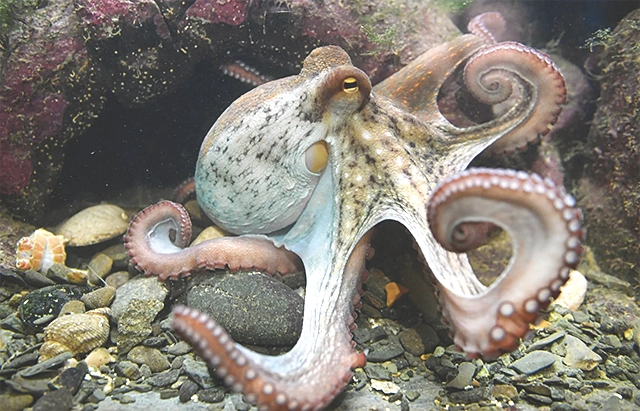
Octopuses can open jars, solve puzzles, and change color in a split second, yet scientists have long wondered how a soft‑bodied relative of clams and scallops ended up with the largest brain of any invertebrate. A new study from the University of Vienna suggests that part of the answer may lie in how octopus DNA is folded inside their cells.
Published on October 9 in Nature Communications, the research compared octopuses, squid, and cuttlefish—species that share a common ancestor that lived hundreds of millions of years ago. At some point in that ancestor’s history, large sections of its DNA were broken apart and stitched back together in a new order.
DNA does not sit in a cell as a neat, straight strand; it folds into a tangled three‑dimensional structure. When distant stretches of the strand come into close proximity, they can influence how active a gene is. The ancient rearrangement created new contacts, forming what the authors call regulatory entanglement, which may allow a species to develop new traits while keeping essential biological functions stable.
The team mapped the folded DNA of a bobtail squid, a cuttlefish, and a California two‑spot octopus. While the broad layout of the DNA stayed largely the same across all three, the smaller connections between distant DNA spots differed widely between species, body tissues, and stages of development, and many sat near genes tied to key cephalopod traits, including the nervous system. The octopus stood out, showing more rearrangement and creating more connections between regions that once sat far apart. In an experiment with a relative of the bobtail squid, deleting a roughly 1,000‑base stretch of DNA inside one of those connected regions caused developmental delays, smaller brains, and altered activity of distant genes, indicating that folded genome parts work together. These findings challenge the view that genome shape is a passive byproduct of evolution and suggest that octopus intelligence may be partly written in the layout of its DNA, a pattern that may also apply to its squid and cuttlefish relatives.