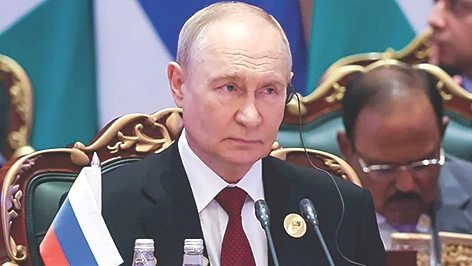
At the concluding session of the BRICS summit in New Delhi on September 13, Russian President Vladimir Putin outlined a new insurance mechanism and a collaborative grain market for BRICS members. He urged the bloc to adopt a holistic approach to address pressing global challenges, citing the economic pressure from Western sanctions.
The G‑7, the European Union and the United Kingdom have barred Western insurers from covering ships that transport Russian crude unless the oil is sold at or below a specified price cap. The insurance restrictions have weakened Russian crude exports, prompting the need for alternative mechanisms.
Putin also proposed a dedicated platform to foster economic growth among BRICS and other Global South nations. He highlighted the New Development Bank’s successful management of projects worth USD 140 billion and emphasized that BRICS can move capital, labour and technology independently of external pressure.
He called for a holistic strategy that tackles both symptoms and root causes of global challenges, urging Global South countries to advance better governance structures and address traditional and non‑traditional security threats. Putin stressed that BRICS’ rising global stature reflects its commitment to an independent, law‑guided course.
The BRICS group, originally comprising Brazil, Russia, India, China and South Africa, expanded in 2024 to include Egypt, Ethiopia, Iran, the United Arab Emirates and Saudi Arabia, with Indonesia joining in 2025. Together with partner countries such as Belarus, Bolivia and others, the bloc now represents about 49.5 percent of the world’s population, 40 percent of global GDP and 26 percent of world trade.