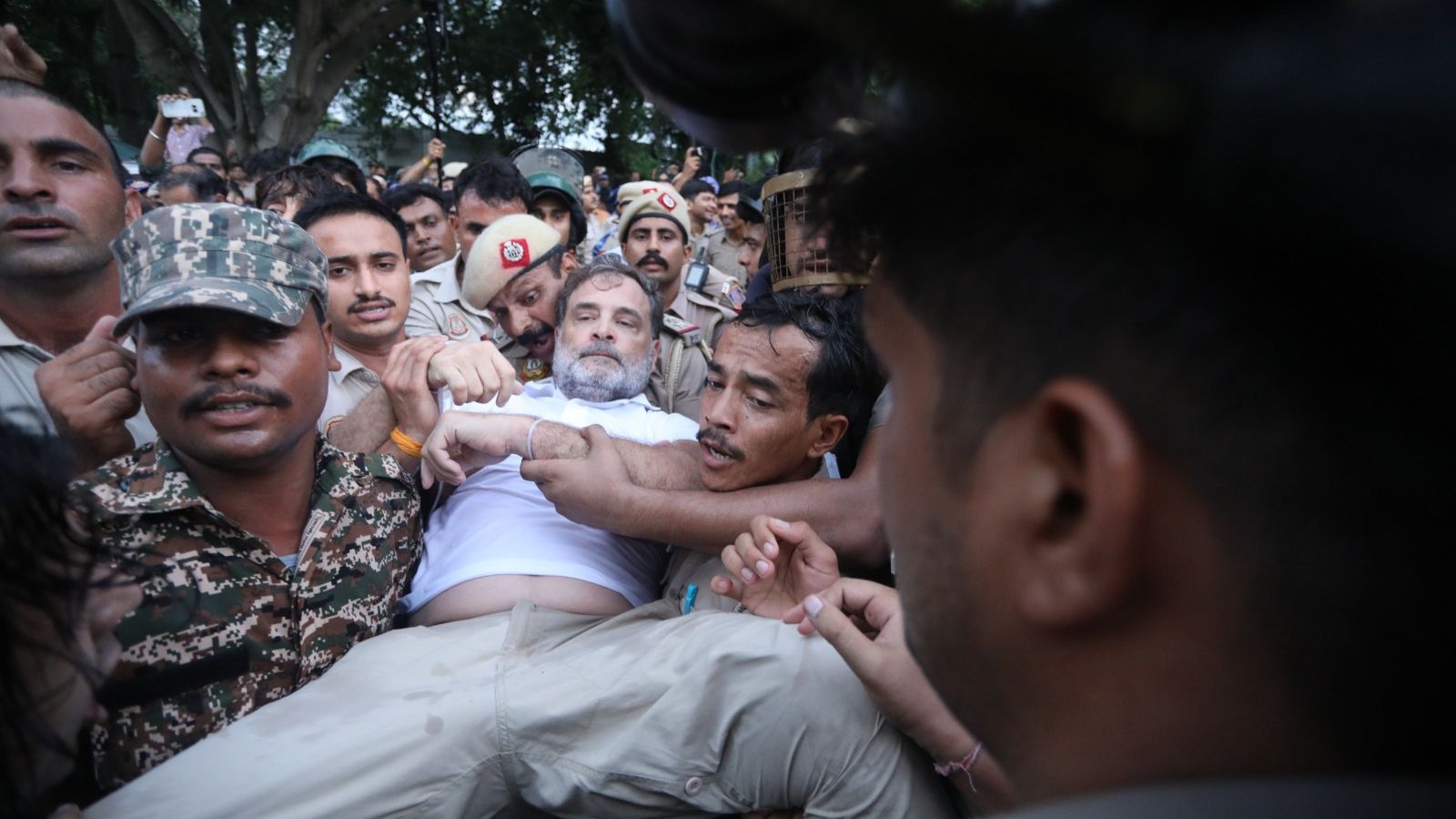
Opposition parties rallied behind thousands of young protesters on Tuesday, visiting the protest site, meeting the injured, echoing their demands, and staging a sit-in outside the Prime Minister’s residence in New Delhi. This comes a day after police used tear gas and lathis to stop the protesters from marching towards Parliament to seek the resignation of Union Education Minister Dharmendra Pradhan over exam paper leaks. Congress leader Rahul Gandhi led the sit-in outside the Prime Minister’s residence at 7, Lok Kalyan Marg, along with other top leaders, including Congress president Mallikarjun Kharge, Karnataka Chief Minister D K Shivakumar, Congress leader and MP Priyanka Gandhi Vadra, and Samajwadi Party president Akhilesh Yadav.
They were later detained and released. Gandhi was taken to Chhatrasal Stadium in the Model Town area, while Vadra was taken to Mandir Marg police station. Congress Parliamentary Party chairperson Sonia Gandhi reached the Mandir Marg police station, and Congress workers showed up at the Chhatrasal stadium.
In a video released late on Tuesday night after his release, Gandhi said the entire Opposition wants a discussion on the ‘biggest issue’ on Wednesday. He also suggested that Prime Minister Modi should apologize to students for ‘what was done by his government and Home Minister on Monday.’ The government agreed to Gandhi’s demand for a discussion in Parliament on the issue of paper leaks, but he later went back on his word and insisted that Pradhan must resign. Pradhan hit out at Gandhi and the Congress, saying they ‘continue to shamelessly exploit students as political tools to manufacture disruption during the Monsoon Session of Parliament.’ He also criticized them for ‘causing inconvenience to the public and disregarding established security protocols’ by staging a dharna outside the PM’s residence.
The AAP targeted the Congress, claiming that its dharna was an attempt to divert attention from the Cockroach Janta Party’s protest. AAP MP Sanjay Singh said, ‘To weaken the CJP’s dharna, Modi ji has allowed Rahul Gandhi to protest outside his residence.’ The Congress was out to reclaim the space, especially since the protests Monday reflected the anger among a section of the youth. NCP (Sharad Pawar) leader Supriya Sule and SP’s Akhilesh Yadav joined the protest.
Gandhi did not keep his word, according to Minister of State Jitendra Singh. Singh said Gandhi initially demanded that the government agree to a discussion in Parliament on the NEET issue and the ongoing protest at Jantar Mantar. However, when the government agreed, Gandhi went back on his word and sought an assurance on Pradhan’s resignation.
The police moved in to detain the Opposition leaders and took them away in buses. The protest was not confined to students, or political leaders and workers. As the crowds swelled at Jantar Mantar, khap leaders and villagers from neighbouring states arrived carrying banners expressing solidarity with the youth.
Many like Shaila had found each other through social media. WhatsApp groups and online communities helped strangers coordinate overnight train journeys, share accommodation, arrange meeting points, and travel together to Delhi. The Mumbai-based consultant took leave from work, boarded an overnight train to Delhi and planned to return the very same night. ’I cannot be apolitical right now.
Anyone who loves their country should be here. I have come alone but I have made many friends,’ she explained. Interestingly, many students insisted they had not come to support the CJP or any political outfit. ’We don’t care about (CJP founder Abhijeet) Dipke.
This is about us. This is about Sonam sir, who sat on a hunger strike for us. We don’t know what the CJP is up to—they may or may not deserve our trust.
We are here for reforms,’ one of the students said. As dusk settled over Jantar Mantar, the slogans grew fainter but the conversations did not. What began as a march called by the Cockroach Janta Party had, by the end of the day, evolved into a much broader public agitation.
In Delhi’s unforgiving heat and amid heavy security, the national capital witnessed one of its largest student-led mobilisations in the recent years, drawing students, political leaders, activists and ordinary citizens united by demands for accountability and change. The chants that reverberated through Delhi’s streets found an echo inside Parliament, with the movement outgrowing its organisers to become a wider expression of public discontent. For many who gathered, the turnout suggested that Sonam Wangchuk’s three-week hunger strike had succeeded in pushing education reforms into the national conversation.
Whether Monday’s mobilisation ultimately results in policy changes remains uncertain, but it brought together an unlikely coalition of parents worried about the next generation, students like Gaurav anxious about their future, working professionals like Shaila and Raman who took leave to march, and elderly citizens like Suman, Ashutosh, and Krishan who believed silence was no longer an option.



