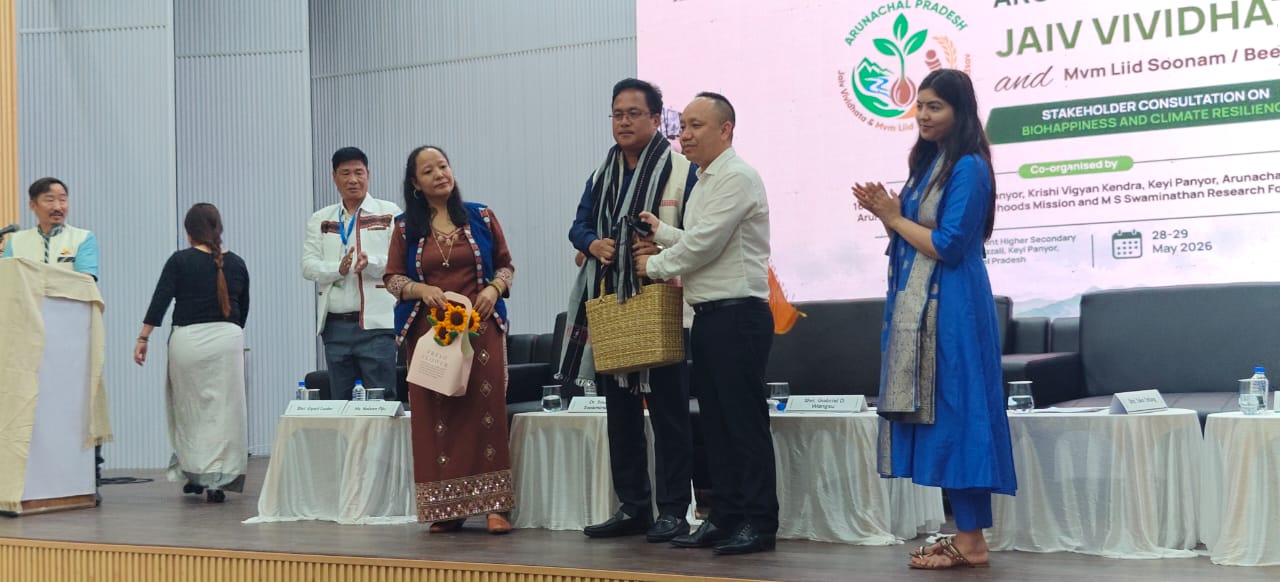
Yazali: Arunachal Pradesh’s rich biodiversity and indigenous knowledge systems took centre stage on Thursday as scientists, farmers, tribal elders, seed conservers, policymakers and youth gathered in Yazali for the opening day of the Arunachal Pradesh Jaiv Vividhata and Mvm Liid Soonam/Beej Utsav 2026.
The two-day stakeholder consultation on biohappiness and climate resilience drew national and international attention to the state’s ecological wealth and coincided with Keyi Panyor district being recognised as India’s first “Bio-Happy District”.
The event was organised by the 16th Yachuli MLA Office, Krishi Vigyan Kendra (KVK) Keyi Panyor, Arunachal State Rural Livelihoods Mission (ArSRLM) and the M.S. Swaminathan Research Foundation (MSSRF).
Inaugurating the event, Agriculture, Horticulture and Allied Sectors Minister Gabriel D Wangsu described the district’s recognition as a historic achievement for both Keyi Panyor and Arunachal Pradesh.
Imphal: The abduction and killing of six Naga civilians allegedly by Kuki militants on May…
The road from Tuensang to Noklak does not welcome visitors. It climbs through the Naga…
This is the second in a three-part series about the author’s trek to the summit…
The Assam Government has passed the Uniform Civil Code (UCC) Bill in the Assam legislative…
Imphal: For nearly a month, the family of Rev Dr Manu Thiumai lived between hope…
“Today, the world is searching for sustainable models of development. And I say this with great pride that the answers already exist in Arunachal Pradesh,” Wangsu said.
Highlighting the growing threat of climate change, the minister warned that erratic rainfall, shorter winters and increasingly severe floods are already affecting traditional agriculture and rural livelihoods. He stressed the importance of conserving indigenous rice varieties and traditional crops, arguing that their loss would not only erode cultural heritage but also undermine future food security.
Wangsu also welcomed efforts to secure intellectual property rights for indigenous crops, referring to an application filed by Hage Nanya of Ziro under the Protection of Plant Varieties and Farmers’ Rights (PPV&FR) Act for 12 indigenous paddy varieties from Lower Subansiri district.
“Such initiatives are extremely important because they protect our traditional crops from biopiracy while ensuring recognition and benefit-sharing for our farming communities,” he said.
The minister called for strengthening seed villages, community seed banks, local seed certification systems, cold storage facilities and farmer-led cooperative seed production. He also underlined the crucial role played by women in preserving biodiversity.
“Women have been the true custodians of biodiversity. A truly Bio-Happy District must first be a gender-just district,” Wangsu said, adding that the government would continue investing in women farmers through training, technology and market access.
Yachuli MLA Toko Tatung used his inaugural address to argue that indigenous communities possess knowledge systems that offer practical solutions to many of the environmental and social challenges confronting the world today.
Speaking on the theme “From Seed to Sovereignty: Why the Future of Humanity Must Listen to Indigenous Civilisations”, Tatung highlighted how traditional farming and ecological practices have evolved through generations of adaptation to local environments.
“In our villages, elders still remember which millet survives heavy rain, which rice can endure drought, which tuber heals weakness, which forest herb protects childbirth, and which bamboo flowers before ecological shifts. Modern institutions call this traditional knowledge. For us, it is simply life,” he said.
Tatung also unveiled the Keyi Panyor Vision Plan 2040, a community-driven development framework focused on food forests, biodiversity conservation, women-led agro-processing, cooperative economies, renewable energy and participatory governance.
Questioning prevailing notions of development, he said indigenous communities have often been viewed as populations to be developed rather than knowledge systems capable of guiding humanity towards ecological balance.
“The world speaks of climate resilience. Our mixed farming systems already evolved through ecological adaptation,” he said.
Chairperson of MSSRF, Dr Soumya Swaminathan, emphasised the global significance of Arunachal Pradesh’s biodiversity, describing it as a repository of plant, animal, insect and bird species, many of which remain undocumented.
She noted that traditional knowledge associated with these biological resources has sustained local communities for generations through food, medicine, construction and handicrafts.
Swaminathan highlighted the example of a farmer from Ziro who has conserved nearly 20 paddy varieties over five decades without formal recognition or financial reward.
“They are not getting any recognition for this. But why are they doing it? Because they feel that if we abandon this, our traditional knowledge will be lost,” she said.
She also stressed that indigenous crop varieties are often better suited to withstand extreme weather conditions linked to climate change than commercially introduced hybrids.
Calling for scientific research on local bio-resources, Swaminathan advocated a model of sustainable development based on natural farming, plastic-free living and carefully managed eco-tourism.
“Arunachal can show an example to the rest of the world, rather than adopting things from the rest of the world,” she said.
Padma Bhushan awardee Rajeev Sethi, designer, scenographer and architect, urged Arunachal Pradesh to avoid replicating environmentally destructive development models.
Drawing on his long association with the state, Sethi advocated the use of bamboo and locally sourced materials in construction and expressed concern over the decline of traditional architecture and indigenous crafts.
“Development? Yes. But destruction in the name of development? No,” he said.
Addressing the youth, Sethi encouraged them to embrace technology without allowing it to undermine their cultural identity and ecological values.
“Use technology, but don’t let technology become your master. You are the master of technology,” he said.
The festival also features exhibitions of indigenous seed varieties, interactions between scientists and custodian farmers, youth dialogue sessions and workshops aimed at strengthening links between culture, biodiversity conservation and sustainable development.
The consultation continues on Friday with discussions expected to focus on climate resilience, community seed systems and pathways for integrating indigenous knowledge into future development planning.
Source: EastMojo