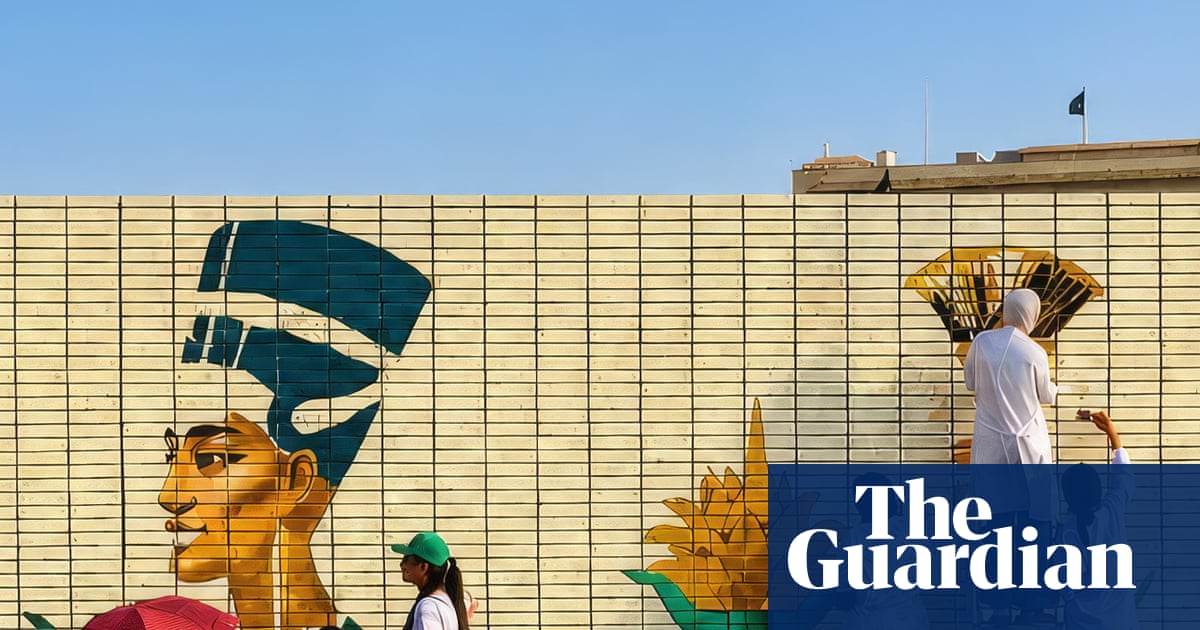
On the eve of Chinese President Xi Jinping’s state visit to Cairo, authorities removed a 66‑metre mural from Tahrir Square so it would not be seen by the visiting delegation. The painting, which depicted Pharaoh Tutankhamun and Queen Nefertiti, was one of 40 murals commissioned to beautify the city for the arrival.
The work was completed in just five days in late August by a volunteer group called Rasmet Basma, led by 22‑year‑old Ahmed Moussa. The team used ChatGPT to generate the designs, which volunteers then painted onto the wall. A golden‑bronze tone was chosen, but the resulting shadows made the figures appear dark‑skinned at night, sparking criticism.
The mural was removed just hours before Xi landed, after Egyptian officials and social media users raised objections. Cairo’s deputy governor and district head had praised the murals during the process, but the controversy grew when posts suggested the figures were portrayed in a way that supported Afrocentric claims about the pharaohs’ origins. Former antiquities minister Zahi Hawass said the volunteers should not have painted a significant public space without expert oversight and dismissed the notion that ancient Egyptian civilisation was linked to sub‑Saharan Africa.
The incident follows a long‑running debate over the complexion of ancient Egyptians. In 2023 a Netflix documentary sparked discussion after casting a dark‑skinned actor as Cleopatra, and in June 2024 a guide’s Afrocentric perspective at Cairo’s Egyptian Museum reignited controversy. Egyptologist Monica Hanna described Afrocentric claims as pseudoscience, noting that Egyptian society has always been ethnically diverse, from Nubian communities in the south to Mediterranean populations in the north.
Experts on artificial intelligence warned that tools such as ChatGPT reflect the most widely shared online information rather than factual accuracy. Walid Mahmoud, an AI researcher, said the content generated by such tools could shape how audiences see themselves, and that they should not be accepted as definitive. Art critic Mostafa Eissa added that AI should remain a tool, not a decision‑maker, and that the human element is essential to preserve originality in art.