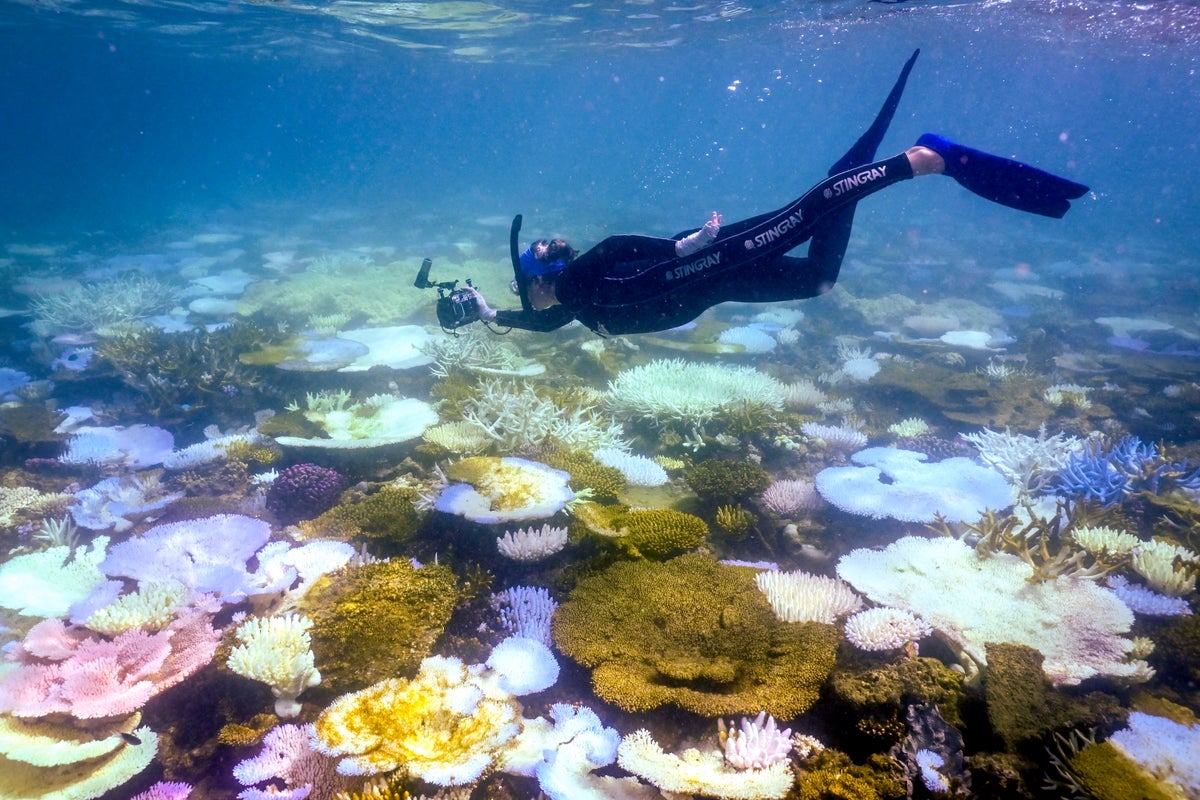
The Great Barrier Reef is at very high risk of severe and widespread coral bleaching due to a record-strength El Niño building in the Pacific, scientists warn. Researchers at the International Coral Reef Symposium in Auckland stated that the coming event could kill coral across vast stretches of the reef and wipe out some species in particular areas. The reef, which runs for 2,300km along the coast of Queensland in northeast Australia, roughly equivalent to the length of Britain travelled three times over, is the largest living structure on Earth and among the country’s biggest tourist draws.
Coral bleaching occurs when water stays unusually warm for weeks at a time, causing corals to expel the algae living in their tissue, which supply most of their food and give them their color, leaving them white and starving. Morgan Pratchett, a marine conservation ecologist at James Cook University in Queensland, expressed concern over the strength of this year’s El Niño, stating that it’s a very high likelihood that the reef will see very high severity and large-scale mass bleaching. He also warned that the next major disturbance could lead to localized species extinctions and widespread ecosystem collapse.
The reef is already weakened, with hard coral cover falling substantially across the reef in 2024 and 2025 after above-average water temperatures caused its sixth mass bleaching event since 2016. Ocean acidification, caused as seawater absorbs carbon dioxide from the atmosphere, is also making it harder for new coral to grow. In addition to these pressures, the reef faces threats from extreme weather, run-off from farmland along the Queensland coast, coastal development, and outbreaks of the coral-eating crown-of-thorns starfish.
Experts emphasize that the damage to the reef serves as a warning of what lies ahead more broadly. Ove Hoegh-Guldberg, a professor of marine studies at the University of Queensland, stated that the lack of action by governments has put the future of coral reefs worldwide in doubt, and that the response so far has not matched the scale of the problem. He likened the situation to being on a sinking ship, saying, “This could be the precursor to the loss of humans…
If you were on a big boat, like the Titanic, and someone comes up to you and says the boat’s going down, you bloody well get on those lifeboats and start acting and do stuff.“ The reef avoided being added to the list of world heritage sites in danger earlier this month, despite the UN expressing utmost concern about mass bleaching and the effects of climate change. Unesco has monitored the site every year since 2021, when it first warned the listing was possible.